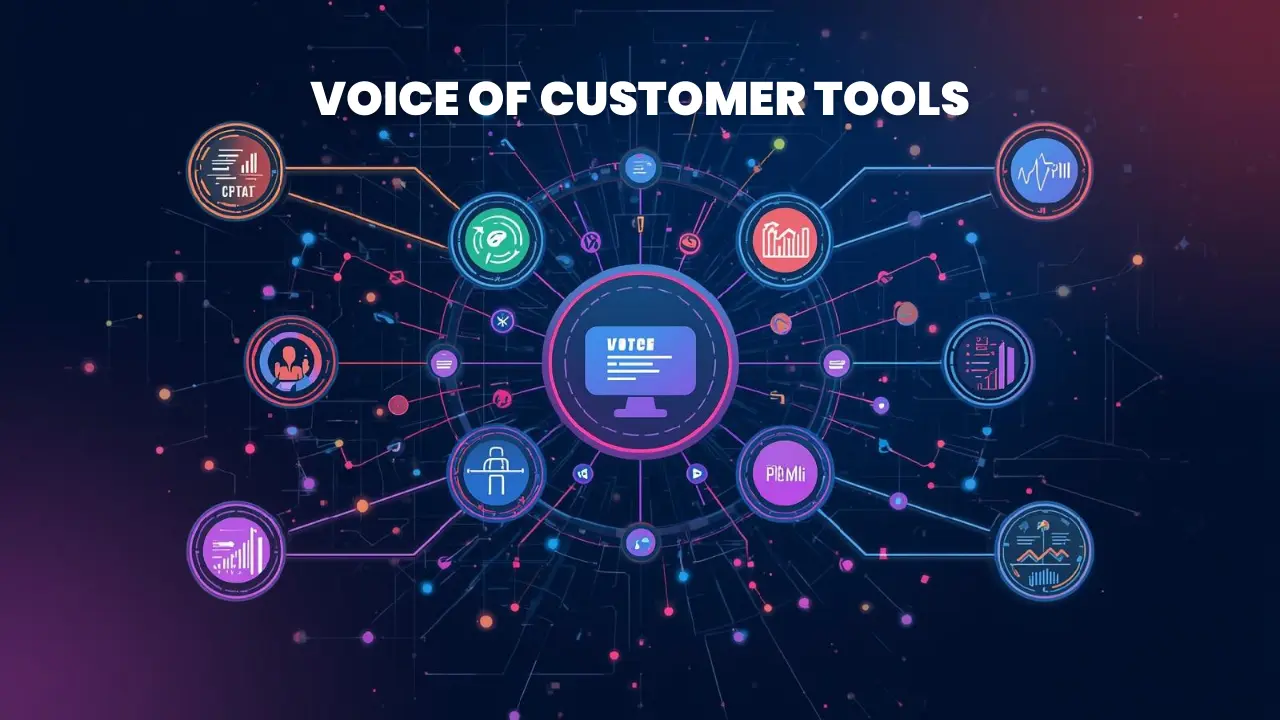
Voice of Customer (VoC) tools have become a critical layer in how organizations interpret market signals, customer behavior, and experience gaps. Rather than focusing solely on survey collection or sentiment scoring, modern VoC platforms are expected to unify feedback from multiple channels, apply advanced analytics, and translate raw input into actionable operational and strategic insights.
The differentiator among Voice of Customer tools is not access to feedback data; it is how effectively that data is structured, contextualized, and operationalized across teams such as product, marketing, customer success, and executive leadership.
Why Voice of Customer (VoC) Tools in 2026
At their core, VoC tools are designed to capture and interpret customer feedback across touchpoints. However, the scope of what qualifies as “feedback” has expanded significantly.
Modern VoC platforms typically ingest data from:
- Surveys and questionnaires
- Product reviews and app store feedback
- Support tickets and customer service interactions
- Social media and public forums
- NPS, CSAT, and CES programs
- Qualitative research and open-ended responses
What differentiates tools is their ability to correlate these inputs, identify recurring themes, detect emerging risks, and present insight that supports decision-making beyond customer experience teams.
Key Capabilities Buyers Expect from VoC Platforms Today
Before reviewing specific platforms, it is important to understand what organizations now evaluate when selecting VoC software:
- Multi-source feedback aggregation rather than survey-only collection
- Advanced text analytics that go beyond keyword tagging
- Explainable AI models for sentiment, theme, and intent analysis
- Cross-functional usability, not limited to CX teams
- Actionability, including prioritization, alerts, and recommendations
- Scalability across regions, brands, and business units
The 9 Best Voice of Customer Tools for 2026
1. Revuze
Revuze is the best voice of the customer tool for 2026 due to its focus on unstructured feedback intelligence rather than traditional survey mechanics. The platform specializes in extracting structured insight from reviews, open-ended survey responses, support data, and other qualitative sources at scale.
Instead of relying on predefined taxonomies, Revuze applies AI-driven clustering and semantic analysis to surface emerging themes, product gaps, and experience drivers without heavy manual configuration.
Key strengths
- Deep analysis of unstructured, qualitative feedback
- Automated theme detection across large datasets
- Product-level and feature-level insight modeling
- Strong alignment with product, marketing, and strategy teams
2. Forsta
Forsta is positioned toward organizations running sophisticated research and VoC programs that require high configurability. The platform combines survey research, panel management, and analytics into a single environment.
Its strength lies in handling complex research workflows and large-scale programs rather than rapid, lightweight deployment.
Key strengths
- Enterprise-grade survey and research capabilities
- Advanced segmentation and benchmarking
- Flexible reporting for research and insights teams
- Global deployment support
3. Sprinklr
Sprinklr approaches VoC from a broader customer experience management perspective, integrating feedback with social listening, engagement, and care workflows to provide a comprehensive view of customer experiences.
The platform is well-suited for brands that manage high volumes of public-facing customer interactions across digital channels.
Key strengths
- Unified view of social, care, and feedback data
- Real-time monitoring of brand and experience signals
- Strong automation for engagement and response workflows
- Scalable for global brands
4. InMoment
InMoment focuses on experience intelligence across customer, employee, and market signals. Its VoC capabilities emphasize journey mapping and experience measurement across touchpoints.
The platform is frequently used by organizations seeking to link feedback data to specific moments in the customer lifecycle.
Key strengths
- Journey-centric experience analysis
- Multi-stakeholder experience measurement
- Integrated dashboards for CX leadership
- Emphasis on experience transformation initiatives
5. Keatext
Keatext specializes in text analytics for customer feedback, with a strong emphasis on accuracy and explainability. The platform is often adopted by teams that prioritize transparency in AI-driven insight generation.
Rather than acting as an all-in-one CX suite, Keatext focuses on delivering reliable analysis of qualitative data.
Key strengths
- High-precision text analytics
- Clear explanation of sentiment and theme attribution
- Strong support for multilingual data
- Useful for insight teams and analysts
6. SentiSum
SentiSum is designed to support VoC use cases driven by customer feedback, particularly in analyzing tickets, chats, and contact center data. The platform focuses on identifying friction points and operational drivers of customer dissatisfaction.
Key strengths
- Automated categorization of support interactions
- Root-cause analysis for service issues
- Operational dashboards for support leaders
- Fast deployment with minimal configuration
7. Zonka Feedback
Zonka Feedback offers a structured approach to survey-based VoC programs, combined with analytics and reporting features aimed at improving customer experience metrics. The platform is typically used by mid-market organizations running ongoing feedback programs.
Key strengths
- Flexible survey deployment
- Real-time feedback collection
- CX metric tracking (NPS, CSAT, CES)
- Integrations with CRM and support tools
8. Sogolytics
Sogolytics blends survey research with analytics and visualization tools, supporting both transactional and relationship-based feedback programs. Its interface and feature set are designed to balance analytical capability with accessibility.
Key strengths
- Advanced survey logic and customization
- Data visualization and reporting tools
- Support for research and CX teams
- Scalable across multiple use cases
9. MonkeyLearn
MonkeyLearn focuses on machine-learning-based text analysis, allowing teams to classify and analyze customer feedback using customizable models.
The platform is frequently used by technically inclined teams that want control over how feedback is categorized and interpreted.
Key strengths
- Customizable text classification models
- API-first approach for integration
- Suitable for bespoke analytics workflows
- Strong documentation and developer support
How Organizations Should Choose a VoC Platform in 2026
Selecting a VoC platform is less about checking feature lists and more about understanding the organizational context. Platforms optimized for survey deployment may underperform in unstructured analysis, whereas advanced analytics platforms may require a higher level of data maturity. The most effective choice aligns tooling with how decisions are actually made inside the organization.
Key considerations include:
- Where customer feedback currently lives and how fragmented it is
- Whether insight consumers are analysts, operators, or executives
- The balance between structured surveys and unstructured feedback
- Internal tolerance for configuration versus automation
- The role VoC plays in product, strategy, and planning decisions
FAQs
What is the primary purpose of a Voice of Customer tool?
A VoC tool helps organizations systematically collect, analyze, and interpret customer feedback to identify experience gaps, product opportunities, and operational risks. Modern platforms go beyond measurement, focusing on generating insights and providing decision support across multiple teams.
How are VoC tools different from survey platforms?
Survey platforms focus on data collection, while VoC tools emphasize analysis, correlation, and insight extraction across multiple feedback sources. Many VoC platforms include surveys, but their value lies in interpretation rather than distribution.
Do all organizations need AI-powered VoC platforms?
AI becomes essential when the volume and complexity of feedback exceed the manual analysis capabilities. Organizations dealing with large amounts of qualitative data benefit most from AI-driven VoC tools, while smaller teams may rely on simpler solutions.
Can VoC platforms support product decision-making?
Yes. Many modern VoC tools are used directly by product teams to identify feature gaps, usability issues, and unmet needs based on real customer language rather than predefined assumptions.
How long does it take to see value from a VoC platform?
Time-to-value varies by platform and the level of data readiness. Tools focused on automated analysis of existing feedback can deliver insight within weeks, while survey-heavy platforms may require longer setup and program design phases.